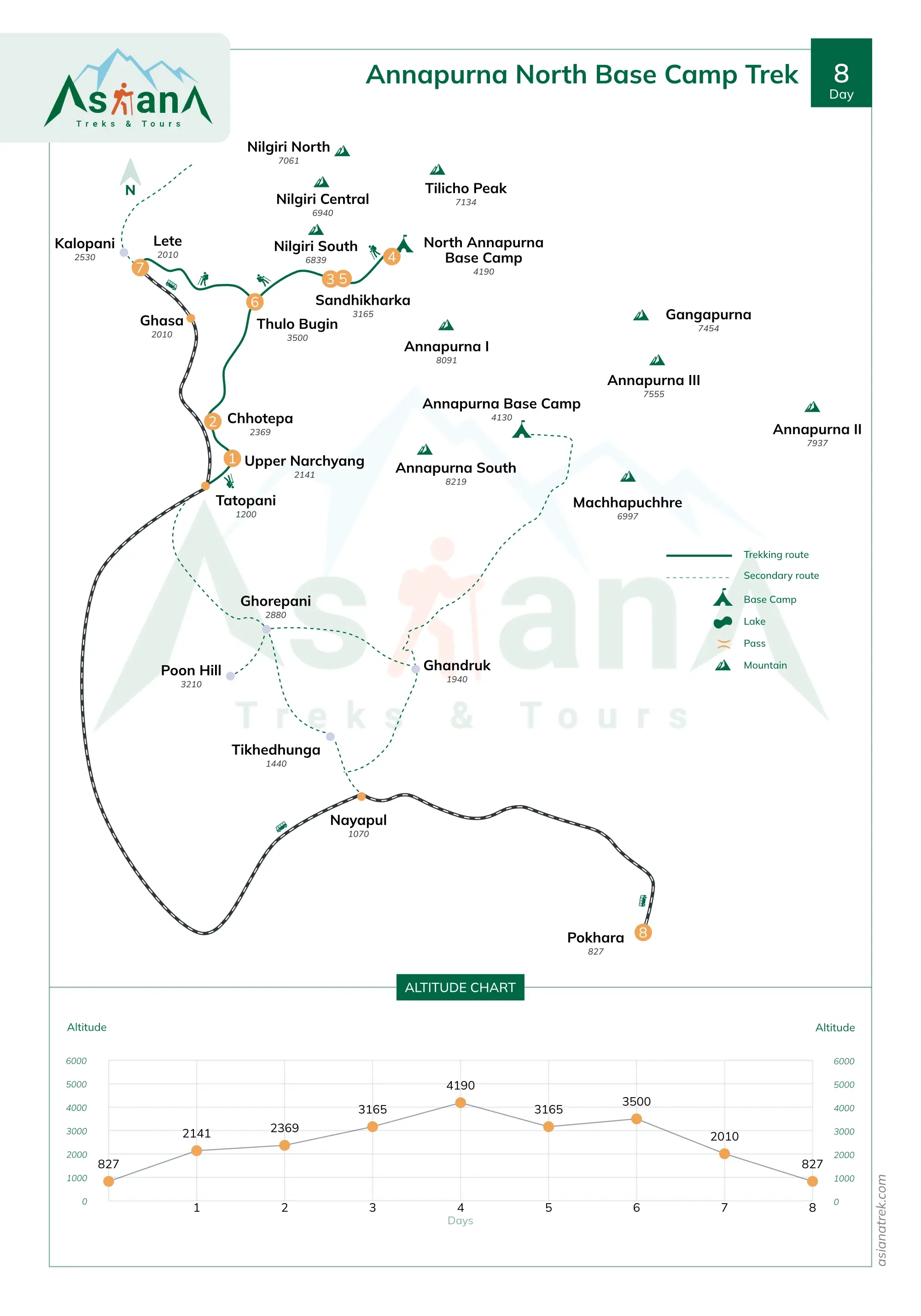
Annapurna North Base Camp Trekking
| Trip code | ATT_ANBC |
| Package name | Annapurna North Base Camp Trekking |
| Duration | 8 |
| Max. elevation | 4190 m |
| Level | Moderate |
| Transportation | All Inclusive |
| Accomodation | Hotel/ Camping |
| Starts at | Kathmandu |
| Ends at | Kathmandu |
| Trip route | Pokhara- Beni- Tatopani- Narchang- Upper Narchang-Chhotepa-Sandhi Kharka- Annapurna North Base Camp-sandhakharka-Thulobugin-Late Pokhara |
| Cost | USD 1,497 per person |
Highlights
- Scenic and Remote Route to Annapurna North Base Camp (4,190m)
- Explore a hidden side of the dramatic mountain vistas and untouched beauty.
- Historic Route of the First Ascent of Annapurna I (8,091m) in 1950, French Expedition Team.
- Follow in the footsteps of Maurice Herzog, who made the first successful ascent of 8,091 Annapurna I.
- Maurice Herzog’s Trail and Legacy and the first footprints to the summit of Annapurna I
- Walk the legendary trail, one of mountaineering’s greatest historical routes.
- Less-Crowded and Off-the-Beaten-Path Adventure Fully Supported Camping Trek
- Discover a peaceful, less-trekked route filled with rich biodiversity, remote valleys, and traditional villages.
- Witness the true Himalayan camping adventure with a diverse Natural Landscape.
- Experience all logistics handled by an experienced crew: guide, cook, kitchen team, and porters.
- Trek through subtropical to Alpine forests, rhododendron valleys,
- Enjoy alpine meadows and glacial moraines in one unforgettable journey.
- Cultural Interaction with Magar, Gurung Thakali Communities
- Explore charming villages like Narchang and Chhotepa, where authentic Himalayan culture is still alive.
- Gradual Altitude Gain for Safe Acclimatisation and reducing the risks of altitude sickness.
- Panoramic Views of Annapurna I, Nilgiri, and Dhaulagiri Range
- Capture rare north-face views of Annapurna and surrounding peaks in a pristine setting.
- Travel through the deepest gorges in the world, surrounded by dramatic landscapes and high cliffs.
- Gaze at the alluring Peace and tranquil Cascade of Rupse waterfall.
- A perfect and Ideal choice for those Adventurers, Seekers, Trekkers
Overview
The Annapurna North Base Camp Trekking Package by Asiana Treks and Tours is a unique and off-the-beaten-path journey for adventure seekers aiming to explore the untouched northern side of the majestic Annapurna range. Unlike the popular southern base camp route, this trek takes you through remote villages, scenic valleys, and dramatic landscapes leading up to the base of Annapurna I (8,091m) from the north side. With a perfect blend of culture and nature, trekkers will experience rural life, traditional Magar villages, and panoramic mountain views rarely seen by mainstream trekkers.
This package includes full support from professional guides, accommodation in local lodges, and transport arrangements from Kathmandu to Pokhara and onwards. It is ideal for seasoned trekkers who seek solitude, authenticity, and the raw beauty of the Himalayas. Asiana Treks and Tours ensures safety, sustainability, and an enriching cultural encounter.
Highlights:
- Rare and scenic northern route to Annapurna I
- Local village homestays and cultural immersion
- Fully guided with logistics and transportation included
Annapurna North Base Camp Trek Itinerary:
The Annapurna North Base Camp Trek Itinerary is a carefully curated 15-day plan that balances trekking, acclimatisation, and cultural exploration. Starting from Kathmandu, the journey continues to Pokhara, then a scenic drive to Ulleri. The trail progresses through Ghorepani, the famous Poon Hill viewpoint, and onward through less-travelled villages like Narchang, Sandhikharka, and Hum Khola before reaching the serene Annapurna North Base Camp (4,190m).
After enjoying the base camp's surreal beauty, the return trail retraces through Sandhikharka and Narchang, then takes a drive to Tatopani, where trekkers can relax in the natural hot springs. The trek ends with a drive to Beni, and finally back to Pokhara and Kathmandu. The itinerary allows time for rest, acclimatisation, and photo opportunities, making it ideal for moderately experienced trekkers.
Trek Itinerary Snapshot:
| Day and Place | Altitude (Meters / Feet) | Distance (Km / Miles) |
| Day 1: Pokhara - Upper Narchang | 1,160 m / 3,805 ft | 98 km / 60.8 mi |
| Day 2: Upper Narchyang -Chotepur | 2,369 m / 7,772 ft | 14.5 km / 9 mi (approx) |
| Day 3: Chhotepur to Sandhi Kharka | ,165 m / 10,384 ft | 10 km / 6.2 mi |
| Day 4: Sandhi Kharka -ANBC | 4,190 m / 13,747 ft | 7 km / 4.3 mi |
| Day 5: Return to Sandhi Kharka | 3,165 m / 10,384 ft | 7 km / 4.3 mi |
| Day 6: Sandhi Kharka - Thulo Bugin | 3,500 m / 11,482 ft | 8 km / 5 mi |
| Day 7: Trek to Lete | 2,010 m / 6,594 ft | 12 km / 7.5 mi |
| Day 8: Drive from Lete to Pokhara | 822 m / 2,697 ft | 123 km / 76.4 mi |
Annapurna North Base Camp Trek Distance:
The Annapurna North Base Camp Trek typically covers approximately 55 to 65 kilometres (34 to 40 miles). This distance may vary slightly based on your exact starting and ending points, chosen campsites, and any side trails taken. Due to its remote location and limited infrastructure, the trail remains relatively less trodden, adding to the journey's uniqueness.
Distance Overview in Points:
- The trek begins after a drive from Pokhara to Tatopani (98 km).
- From Tatopani, trekkers gradually ascend through Upper Narchyang, Chhotepa, and Sandhi Kharka, and finally reach the Annapurna North Base Camp at 4,190 meters.
- The return route descends via Thulo Bugin and Lete, concluding with a 127 km drive back to Pokhara.
- Tatopani to Upper Narchyang (Trek) – Approx. 5–6 km
- Upper Narchyang to Chhotepa – 9 km / 5.5 miles
- Chhotepa to Sandhi Kharka – 10 km / 6.2 miles
- Sandhi Kharka to Annapurna North Base Camp – 7 km / 4.3 miles
- Return route via Thulo Bugin to Lete – Approx. 20–25 km (12–15 miles) combined
- Lete to Pokhara (Drive) – 123 km / 76.5 miles
Annapurna North Base Camp Trekking Cost 2026/2027:
Trekking to the remote and pristine Annapurna North Base Camp is a unique Himalayan adventure. With Asiana Treks and Tours, the trekking cost for the 2026/2027 season ranges between USD 1,200 $1,450 per person, depending on the group size, customisation level, and selected service inclusions.
This is a fully supported camping trek, offering exceptional value with personalised logistics and services that cater to comfort, safety, and cultural immersion in a remote environment.
This Annapurna North Base Camp Trek package includes all accommodations in Star Hotels in Kathmandu and Pokhara, traditional village homestays, and fully supported Tents. Trekkers receive three nutritious meals per day during the trek, prepared by our private cook. The cost also covers all required permits, including ACAP and TIMS. A dedicated team of licensed trekking guides, a cook, a kitchen boy, porters, and helpers ensures your safety and comfort. High-quality camping gear and cooking equipment are provided to support this remote adventure. Additionally, round-trip ground transportation from Kathmandu to Pokhara and to Tatopani or Lower Narchang is included to ensure a smooth, worry-free trekking experience.
Trekking Cost Breakdown for Annapurna North Base Camp Trek:
| Group size | Trek cost Per Person in US$ | Inclusion |
| 1 Person (Solo Trekker) | $1,555 | Private guide, solo logistics, full support, Camping |
| 2–4 Persons | $1,350 | Shared services, guided & supported camping |
| 5+ Persons | $1,225 | Group rate with full logistical support |
Annapurna North Base Camp Trek Price:
Asiana Treks and Tours provide the Annapurna North Base Camp Trek. This gives trekkers a clear understanding of where their money goes and what to expect in terms of cost planning
Estimate the price of the North Base Camp Trek:
- Annapurna Conservation Area Permit (ACAP) and TIMS card.
- Transportation Kathmandu to Pokhara, Pokhara to Tatopani, continuing to Lower Narchang and back to Kathmandu Via Lete
- Covers bus/private jeep from Kathmandu to Pokhara and transfers to Ulleri and back via Beni/Tatopani.
- Necessary Guide & Porter Wages
- Includes wages, insurance, meals, and accommodations for the trekking crew.
- Lodges and basic teahouse stays along the trail (shared or private, based on availability).
- Full board meals during the trek, including tea/coffee, varying by altitude and remoteness.
- Miscellaneous Emergency Fund and emergency buffer.
Annapurna North Base Camp Trek Altitude Guide:
The Annapurna North Base Camp Trek features gradual altitude gain, which supports safe acclimatisation. Starting at Tatopani (1,160m), the trail steadily ascends through peaceful villages like Upper Narchyang, forested areas like Chhotepa, and high alpine camps like Sandhi Kharka, before reaching the maximum altitude of 4,190m at Annapurna North Base Camp. This trek minimises the risk of Acute Mountain Sickness (AMS) due to its moderate daily elevation gain. On the return route, trekkers descend via Thulo Bugin and Lete, which helps in a smooth transition back to lower altitudes. This route combines scenic diversity, cultural immersion, and safe altitude transitions—perfect for trekkers seeking an off-the-beaten-path Himalayan adventure.
- Key Altitude Points – In Brief
- The trek starts at Tatopani (1,200 m) and gradually climbs to Annapurna North Base Camp (4,190 m).
- The trail allows natural altitude adjustment due to steady elevation gain.
- Acclimatisation-friendly with overnight stays at increasing elevations.
- The highest sleeping point is typically below 4,200 meters, reducing the risk of altitude sickness.
- The trek descends via Lete and Tatopani, offering relief after the summit.
High-altitude guide meter and fit, Altitude Meter gain and loss of Annapurna North Base Camp Trek:
| Name of the place | Altitude in meters/ Fit | Altitude Gain/Loss |
| Tatopani | 1,200 m / 3,937 ft | +378 m / +1,240 ft from Pokhara |
| Lower Nanchang | 1,900 m / 6,233 ft | +700 m / +2,296 ft |
| Upper Narchang | 2,200 m / 7,217 ft | +300 m / +984 ft |
| Chotepa | 2,650 m / 8,694 ft | +450 m / +1,476 ft |
| sandhikharka | 3,300 m / 10,827 ft | +650 m / +2,133 ft |
| Annapurna North (Base Camp | 4,190 m / 13,747 ft | +390 m / +1,280 ft (highest point) |
| Tholo Bugin | 3,800 m / 12,467 ft | +500 m / +1,640 ft |
| Lete | 2,480 m / 8,136 ft | -1,710 m / -5,610 ft |
| Pokhara | 822 m / 2,697 ft | -378 m / -1,240 ft |
Why Choose Annapurna North Base Camp Trek?
The Annapurna North Base Camp Trek is a rare gem in the world of Himalayan trekking, offering an exclusive path to the less-visited north face of Annapurna I (8,091m). Unlike the crowded southern base camp route, this trek leads you through untouched valleys, peaceful forests, and authentic Magar and Gurung villages. It’s perfect for trekkers looking to escape the popular circuits and explore the remote beauty of central Nepal. Asiana Treks and Tours specialises in guiding travellers through this pristine landscape with safety, cultural depth, and environmental responsibility in mind.
With panoramic views of the Annapurna range, peaceful trails, and warm local hospitality, this route offers both physical challenge and emotional reward. The journey includes visits to Pokhara, Ghorepani, Poon Hill, Narchang, and the awe-inspiring Annapurna North Base Camp at 4,190m.
Why Choose This Trek:
- Less crowded and more authentic route
- Panoramic Himalayan views from both Poon Hill and Base Camp
- Guided by experienced locals with full logistics support
- Cultural immersion in the Magar and Gurung communities
Preparing for the Annapurna North Base Camp Trek:
Preparation is key for a successful trek to the Annapurna North Base Camp, especially considering the varied terrain, remote paths, and high-altitude conditions. Trekkers should aim for a moderate to high level of fitness, with emphasis on endurance and cardiovascular training at least 4–6 weeks before departure. Hikes with loaded backpacks, stair climbing, and long walks will help condition your body for daily treks of 6–7 hours.
Gear selection is equally important. A solid pair of trekking boots, warm clothing layers, a quality sleeping bag, rain gear, trekking poles, and a first-aid kit are essential. Asiana Treks and Tours provides a complete packing checklist and conducts a pre-departure briefing to ensure you're fully prepared. Travel insurance that covers emergency evacuation is mandatory due to the route's remoteness.
Preparation Checklist:
- Train with cardio, stair climbs, and endurance hikes
- Invest in proper trekking boots and layers
- Ensure travel insurance covers high altitude
- Pack essentials: headlamp, water purifier, snacks, personal meds
- Use the complete gear guide provided by Asiana Treks and Tours
What to Expect on the 8–11-Day Annapurna North Base Camp Adventure:
The 8–11-day Annapurna North Base Camp trek is a blend of natural wonder, cultural encounters, and trekking adventure. Starting in Kathmandu, the journey continues to Pokhara and then climbs through traditional mountain villages like Ulleri and Ghorepani, culminating at the famous sunrise viewpoint of Poon Hill. From there, you leave the mainstream trails behind and head deeper into the wilderness toward Narchang, Sandhikharka, and Hum Khola.
The final destination is the spectacular Annapurna North Base Camp (4,190m), where trekkers are rewarded with jaw-dropping views of Annapurna I's north face and surrounding peaks. The return path retraces through scenic villages, then includes a drive from Tatopani to Beni, and finally back to Pokhara and Kathmandu. Expect rustic accommodations, ever-changing landscapes, and heartwarming interactions with locals, all guided by the experienced team at Asiana Treks and Tours.
Trek Highlights:
- Visit iconic locations like Ghorepani and Poon Hill
- Experience remote villages and untouched trails
- Explore diverse ecosystems from lowland forests to alpine meadows
- Witness Annapurna I’s dramatic north face up close
- Relax in Tatopani’s natural hot springs before heading home
Oxygen Levels on the Annapurna North Base Camp Trail:
Trekking to Annapurna North Base Camp (4,190m) involves ascending to high altitudes where oxygen levels naturally decrease. At sea level, oxygen saturation is 100%, but at base camp, it drops to around 60–65%, making it essential for trekkers to acclimatise gradually. The itinerary by Asiana Treks and Tours is specifically designed to allow for safe altitude gain, with overnight stays at villages such as Ghorepani (2,850m), Sandhikharka (3,300m), and Hum Khola (3,700m) before reaching base camp.
To adapt to lower oxygen, trekkers are advised to maintain a slow pace, stay hydrated, and avoid alcohol. AMS (Acute Mountain Sickness) symptoms, such as headache, nausea, or dizziness, can occur if altitude is gained too quickly. Asiana Treks and Tours' guides are trained in high-altitude first aid and carry oximeters to monitor your oxygen levels regularly.
Quick guides:
- Oxygen level at 4,190m is ~60–65% of sea level
- Acclimatisation days are built into the itinerary
- Guides carry pulse oximeters and altitude medicine
- Hydration and slow ascent are key to safety
Major Villages and Scenic Viewpoints on the Annapurna North Route:
The Annapurna North Base Camp Trek is rich in authentic Himalayan culture and stunning scenery. The route takes you through picturesque villages like Ulleri, known for its long stone staircase and Magar community, and Ghorepani, a bustling trekkers’ hub. From Poon Hill (3,210m), trekkers witness a magical panorama of the Annapurna and Dhaulagiri ranges during sunrise, making it one of the most memorable moments of the trek.
As the trail veers off the main route, you'll encounter Narchang, a peaceful hamlet near waterfalls, and Sandhikharka, a secluded village offering breathtaking views of Mt. Nilgiri and the Annapurna Massif. The final highlight is Annapurna North Base Camp, where towering peaks surround you in a dramatic amphitheater of rock and ice. These spots provide insight into local life while showcasing Nepal’s diverse mountain terrain.
Key Villages & Viewpoints:
- Ulleri: Gateway village with scenic terraced fields
- Poon Hill: Iconic sunrise viewpoint at 3,210m
- Narchang & Sandhikharka: Remote, cultural, and scenic
- Base Camp (4,190m): Panoramic views of Annapurna I’s north face
Flora and Fauna of the Annapurna North Base Camp Trail:
The Annapurna North Base Camp trail is a biodiversity hotspot, with ecological zones ranging from lush subtropical forests to alpine tundra. The lower regions around Ulleri and Ghorepani are covered in vibrant rhododendron forests, especially stunning during spring (March–April). Ferns, orchids, pine, and oak trees thrive in the mid-hills, while higher elevations near Hum Khola and base camp support hardy alpine vegetation such as dwarf junipers and medicinal herbs.
Wildlife along this route includes Himalayan Tahr, langurs, musk deer, and, if you're lucky, glimpses of the elusive snow leopard or red panda in the more secluded forest areas. Birdwatchers will also enjoy spotting species such as the Himalayan Monal (Nepal’s national bird), eagles, and Himalayan vultures. Asiana Treks and Tours emphasises eco-friendly trekking practices to help preserve this delicate ecosystem for future generations.
Wildlife & Flora Highlights:
- Rhododendron blooms and alpine meadows
- Musk deer, Himalayan Monal, and langurs
- Snow leopard habitats are in higher elevations
- Diverse forest ecosystems from subtropical to alpine
Festivals and Local Culture Route:
The Mristi Khola Route, leading to Annapurna North Base Camp, offers a unique cultural journey through lesser-known villages such as Narchang, Sandhikharka, and Hum Khola. These settlements are predominantly inhabited by Magar and Gurung communities, whose rich traditions and colourful festivals bring the trail to life. Throughout the year, trekkers might witness traditional celebrations such as Maghe Sankranti (harvest festival), Tihar (festival of lights), or Losar (Tibetan New Year), depending on the season of travel.
Cultural elements are visible in the architecture of stone houses, the use of local costumes, and the rhythm of folk songs and dances. As you travel along this quiet Himalayan corridor, Asiana Treks and Tours ensures respectful engagement with local communities. They often organise homestays or village tours that allow trekkers to share meals and learn customs directly from the people.
Cultural Highlights:
- Experience Magar and Gurung traditions first-hand
- Attend seasonal festivals if visiting during festival months
- Participate in homestays and local village life
- Traditional dances, foods, and rituals along the trail
Why Book with Asiana Treks and Tours for Annapurna North Base Camp:
Booking your Annapurna North Base Camp Trek with Asiana Treks and Tours means choosing professionalism, safety, and deep local knowledge. Unlike generic agencies, Asiana specialises in off-the-beaten-path Himalayan routes, offering fully supported treks through remote areas such as Mristi Khola, Sandhikharka, and Hum Khola, which require specialised logistical planning. Their team consists of licensed, experienced local guides who know the terrain, culture, and emergency protocols.
Asiana also offers custom itineraries based on your pace and interests, with full transparency in pricing. From the moment you arrive in Kathmandu, the company takes care of permits, lodging, meals, transport, and porter services—allowing you to focus solely on the journey. Their commitment to eco-tourism and community support ensures your trek benefits both the environment and the people you meet.
Why Choose Asiana Treks and Tours:
- Experienced in remote routes like Annapurna North
- Trusted, government-licensed guides and porters
- Custom itineraries and transparent pricing
- Strong focus on safety, sustainability, and local benefit
How to Book the Annapurna North Base Camp Trek:
Booking your Annapurna North Base Camp Trek with Asiana Treks and Tours is straightforward and can be done either online or in person upon arrival in Kathmandu. Their website offers an easy-to-use booking form that lets you select the trekking season, group size, and additional services such as private porter support or accommodation upgrades. A small deposit typically confirms your spot, with the remaining balance due before the trek begins.
Once booked, you’ll receive a pre-departure information pack containing a gear checklist, itinerary, and travel advice. If needed, Asiana Treks can also assist with hotel reservations in Kathmandu or Pokhara, airport pickups, and even flight bookings. Their responsive team is available by email or phone to answer any questions and assist with visa requirements or insurance recommendations.
Booking Process:
- Book online or in person at the Kathmandu office
- Flexible dates with guaranteed departures for small groups
- Deposit required to confirm, balance paid before the Trek
- Get a full briefing, packing list, and travel assistance after booking
Trip Preparation
Clothing
- Thermal underwear (top and bottom)
- Moisture-wicking t-shirts (long-sleeved)
- Moisture-wicking underwear
- Fleece jacket or pullover
- Insulated down or synthetic jacket
- Waterproof, windproof jacket (Gore-Tex or similar)
- Waterproof, windproof pants (Gore-Tex or similar)
- Warm beanie or hat
- Sun hat or cap
- Neck gaiter or scarf
- Trekking pants (convertible preferred)
- Waterproof trousers
Handwear
- Lightweight gloves (inner)
- Insulated gloves or mittens (outer)
Footwear
- Hiking boots (broken in and waterproof)
- Comfortable camp shoes (e.g., sneakers or sandals)
Gear
- Trekking backpack (30-40 liters) with waterproof cover
- Sleeping bag (rated for cold temperatures)
- Sleeping pad or mattress (insulated)
- Adjustable trekking poles
- Insulated water bottles or hydration bladder (2 liters capacity)
- Travel-sized toiletries
- Biodegradable soap
- Quick-dry towel
- Medications for altitude sickness, pain relief, and common ailments
- Sun protection cream, wet wipes, and hand sanitizer
Miscellaneous
- Camera and batteries
- Notebook and pen
- Earplugs (for sleeping in lodges)
- Portable solar charger
- Headlamp, power bank, and extra batteries
Trip Itinerary
Day 1 : Pokhara to Tatopani drive then 2 hour Hike Upper Narchang (5 -6 hours)
Begin your journey with a scenic drive from Pokhara, passing lush valleys, terraced hillsides, and charming villages. Arrive at Tatopani, a small town renowned for its natural hot springs and refreshing mountain ambience. After a short break, start your trek towards Upper Narchyang. The trail gradually ascends through vibrant rhododendron forests, across wooden bridges, and alongside cascading waterfalls. You'll walk through culturally rich Magar and Gurung villages, where traditional houses and friendly locals offer a warm welcome.
Upon reaching Upper Narchyang, settle into the peaceful surroundings of this serene mountain village. Surrounded by panoramic views of the Nilgiri and Dhaulagiri ranges, it’s the perfect introduction to the remote beauty and rich culture of the Annapurna North region. This authentic experience offers a true taste of Himalayan life.
Day 2 : Trek from Upper Narchyang (2140m) to Chhotepur.
Leaving the quiet charm of Upper Narchyang, the trail gradually climbs through lush alpine forests, alive with birdsong and the sound of distant waterfalls. This lesser-travelled route offers a peaceful trekking experience far from the crowded paths of popular trails.
Along the way, you’ll pass by herders’ huts, mossy trees, and glimpses of Himalayan wildlife, including rare mountain birds. The surrounding landscape becomes denser and greener, offering the perfect blend of natural beauty and solitude.
Arrive at Chhotepur, a hidden gem nestled in a pristine forest. With panoramic views of the surrounding peaks and the peaceful atmosphere of remote Nepal, Chhotepur offers a refreshing retreat. Here, our crew will prepare a warm, nourishing meal as you unwind and soak in the tranquil mountain ambience.
Day 3 : Trek from Chhotepa (2369m) to Sandhi Kharka (3165m)
Start your day with a gentle climb out of the serene forests of Chhotepa, gradually ascending into more rugged and alpine terrain. As you gain altitude, the scenery transforms—dense greenery gives way to alpine meadows, rocky outcrops, and snow-dusted ridgelines.
This section of the trail is peacefully remote, with hardly any trekkers, making it a perfect path for those seeking true solitude. Along the way, you’ll see glacial streams, icy cliffs, and possibly wildlife adapted to the high-altitude habitat.
Arriving at Sandhi Kharka (3165m), you’ll find yourself surrounded by unspoiled Himalayan wilderness. This tranquil highland meadow is ideal for overnight camping, offering spectacular 360° views of the majestic Annapurna and Dhaulagiri ranges. As the sun sets over the snowy peaks, soak in the silence and sheer grandeur of the Himalayas.
Day 4 : Sandhi Kharka (3165m) to Annapurna North Base Camp (4190m)
Today marks the highlight of the entire journey—the trek to the awe-inspiring Annapurna North Base Camp. The trail ascends steadily from Sandhi Kharka through a dramatic alpine landscape featuring rugged ridges, icy slopes, rockfalls, and narrow glacier-fed paths. Along the way, you’ll cross log bridges, traverse frozen streams, and pass through scattered patches of grasslands and high-altitude shrubs.
As you reach the Annapurna North Base Camp (4190m), you’ll be surrounded by towering Himalayan giants, including the north face of Annapurna I. The setting is stark, majestic, and silent—a true high Himalayan wilderness.
We’ll take time to absorb the panoramic views and take photos before choosing a scenic camping site. After enjoying the base camp, we descend and camp overnight at Chhotepa (2,455m)—the final campsite of the trek. The peaceful surroundings and starry skies mark the perfect end to this unforgettable day in the heart of the Himalayas.
Day 5 : Trek from Annapurna North Base Camp (4190m) to Sandhi Kharka
After an unforgettable sunrise over the Annapurna giants, we begin our descent from the Annapurna North Base Camp. The early morning light reveals new textures in the mountains and valleys we admired the day before.
The trail retraces its way through the high alpine zone, passing glacial moraines, frozen streams, and quiet ridgelines. With every step downward, the air grows slightly warmer, and the landscape begins to soften. It’s a peaceful walk filled with panoramic mountain vistas, making it a perfect time for reflection and appreciation of the journey so far.
By midday, we arrive back at Sandhi Kharka, where the serene wilderness camp awaits. Enjoy a hot meal and relax amidst the tranquil beauty of this high Himalayan hideaway.
Day 6 : Trek from Sandhi Kharka (3165m) to Thulo Bugin
Today’s trail leads through one of the most peaceful and remote sections of the Annapurna North Base Camp route. We begin our journey from Sandhi Kharka, gradually climbing along deserted ridgelines, passing by yak grazing meadows, and trekking through a pristine mix of forest and rocky alpine terrain.
The silence of this section is broken only by the whispering wind or distant bird calls, offering a true off-the-beaten-path experience. After several hours of trekking, we reach Thulo Bugin (3500m), a beautiful open high-mountain meadow.
Thulo Bugin is known for its spectacular views of Himalayan peaks and a night sky full of stars. It serves as a perfect campsite where our camping crew prepares warm meals and sets up tents for a cosy and restful evening in nature.
Day 7 : Thulo Bugin (3500m) to Lete (2010m)
Today, we begin a scenic descent from the alpine meadows of Thulo Bugin toward the lush lowlands of Lete, nestled in the Kali Gandaki Valley. The trail leads us through changing landscapes—open highlands, dense pine forests, and, gradually, vibrant green valleys. Along the way, we are treated to stunning panoramas of the Dhaulagiri and Nilgiri ranges towering above. Crossing the Miristi Khola, one of the most dramatic river crossings of the trek, adds a thrilling element as we pass through narrow gorges and winding paths. This region is completely wild, without settlements—just raw nature and serene silence.
By afternoon, we reach Lete (2010m), a charming village known as a gateway to the Jomsom–Muktinath and Annapurna Circuit routes. Tonight, we stay in a local guesthouse, with time to explore the area, relax, and reflect on our remarkable journey.
Day 8 : Drive from Lete (2010m) to Pokhara
Today marks the final leg of your incredible Himalayan adventure. After breakfast in Lete, we begin our scenic drive back to Pokhara, descending through the dramatic Kali Gandaki Gorge—the deepest canyon in the world, carved between the Dhaulagiri and Annapurna massifs.
The road journey offers captivating views of cascading rivers, terraced hillsides, and remote mountain villages, each echoing the rhythm of traditional Nepali life. As we leave the rugged terrain behind, the lush greenery and peaceful vibe of Pokhara welcome us. Once in Pokhara, unwind at your lakeside hotel, stroll around Phewa Lake, shop for souvenirs, or enjoy a relaxing dinner with views of the Annapurna range reflected on the tranquil waters, marking a perfect end to your North Annapurna Base Camp trek.
Inclusions
What is included?
- Airport transfers (arrival & departure)
- Accommodation 2 nights, Teahouse 7 nights (Camping, tent)
- Transportation To and from Pokhara–Tatopani–Lete-Pokhara.
- All meals during trekking
- Trekking permits (ACAP, TIMS)
- English-speaking guide, Cook, Kitchenboy and necessary porters
- Annapurna North Base Camp trek logistics
What isn't included?
- International airfare
- Nepal visa fees
- Travel insurance
- Personal expenses (snacks, drinks, Wi-Fi)
- Tips for guides & porters
- Accommodation in Kathmandu or Pokhara
Complimentary
- Clear, detailed itinerary breakdown
- Gear and packing guidelines
- Permit and documentation info
- Safety and health advice
- Arrival at Kathmandu (TIA)
- Transfer to Pokhara by flight or road
- Drive from Pokhara to Beni, then to Tatopani
- Trek begins from Tatopani via the Upper Sandhikharaka -Mristi Khola route
- 8–13 day itinerary from Kathmandu to base camp and back
- Key stops: Ulleri, Ghorepani, Poon Hill, Sandhikharka, Hum Khola
- Acclimatisation days included
- Organised transport and accommodation
- Total distance: ~110-130 km round trip
- Duration: 12–14 days
- Elevation gain: 800m to 4,190m (base camp)
- Daily trekking: 5–7 hours on average
- Hotels in Kathmandu and Pokhara
- Camping on the trekking route
- Hot showers are provided in a bucket
- Warm hospitality and scenic views
- Dal Bhat: traditional and filling staple
- Soups, momos, noodles, Pasta, and some Western dishes
- Limited menus at higher elevations
- Emphasis on fresh, hot meals and safe drinking water
- Layered clothing and a waterproof jacket
- Sturdy trekking boots and a sleeping bag
- Daypack, trekking poles, headlamp
- Personal hygiene, first aid, and sun protection
- Portable chargers and water purification
- Consider guided groups or local guides
- Respect local customs; dress modestly
- Prioritise health, hydration, and hygiene
- Maintain communication with Asiana Treks
- Kathmandu to Pokhara by flight or bus
- Jeep or local bus from Pokhara to Beni and Tatopani
- Trekking on foot from Tatopani to base camp
- Asiana handles all transport bookings and transfers
- Cultural tours in Kathmandu Valley
- Boating and sightseeing in Pokhara
- White-water rafting and paragliding
- Village cultural immersion experiences
- Bungee jumping, Hot air ballooning and Zip lining
- Knowledgeable and friendly guides
- Well-managed logistics and accommodation
- Authentic cultural experiences
- Memorable Himalayan scenery
- Transport arrangements to Kathmandu or the airport
- Hotel check-ins and onward travel assistance
- Trekking certificates and photo souvenirs
- Optional day tours and relaxation packages
- Deposit to confirm booking, balance before trek
- Partial refunds based on cancellation timing
- Rescheduling options for emergencies
- Travel insurance recommended
Annapurna North Base Camp – Start Point and How to Get There:
Day-by-Day Annapurna North Base Camp Itinerary:
Trek Distance, Duration & Elevation Gain on the Mristi Khola Trail:
Types of Accommodation on the Annapurna North Base Camp Trek:
Food Options on the Annapurna North Route:
Food Options Summary:
Packing List for Annapurna North Base Camp:
Solo Trekkers & Female Trekker Advice for Annapurna North Base Camp Trekking:
Transportation, Modes: Jeep, Bus, Flight for the North Base Camp:
Add-On Tours After Annapurna North Base Camp:
Feedback & Reviews from Annapurna North Base Camp Trekkers:
Departure Support & End-of-Trek Services:
Booking Terms, Cancellation & Refunds for Annapurna North Packages: