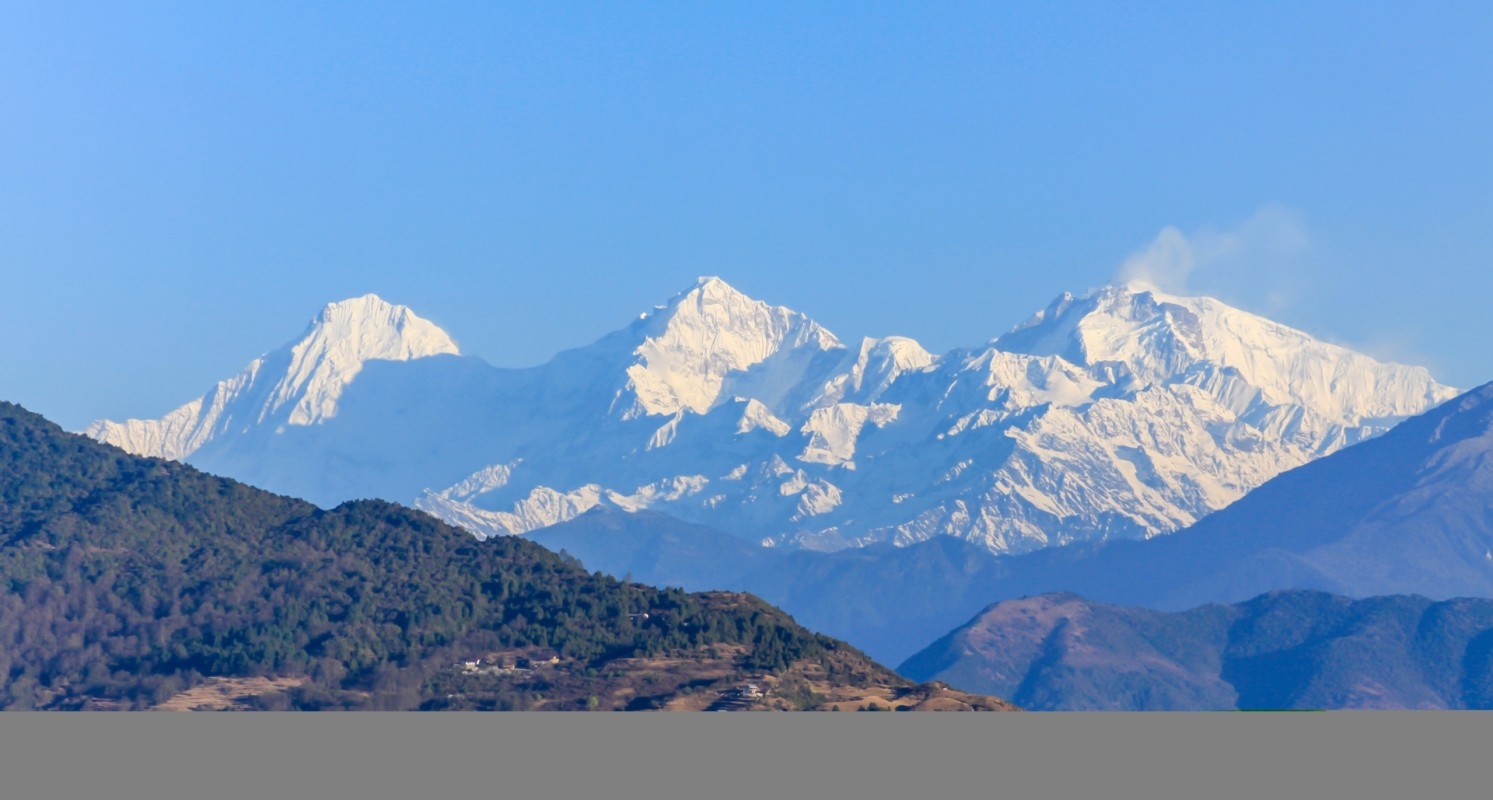
Experience the breathtaking Ganesh Himal region with Asiana Treks and Tours on the Singla Pass Trek, a perfect blend of adventure and culture. Starting from vibrant Kathmandu, explore its rich heritage before driving to Trishuli and beginning your trek through lush valleys, traditional villages, and terraced landscapes. Challenge yourself at Singla Pass (4600 m) while enjoying panoramic Himalayan vistas, then descend through serene settlements like Serthung, Laba, and Arughat Bazaar. Conclude with the historic Gorkha and return to Kathmandu, immersing in Nepal’s natural beauty and cultural charm.
Ganesh Himal is a remote and pristine mountain region located in central Nepal, northwest of Kathmandu. Named after the sacred Hindu god Ganesh, this area remains largely untouched by mass tourism, offering trekkers an authentic and serene Himalayan experience. The trek reveals a unique blend of rich Nepalese culture and stunning natural beauty, making it a rewarding journey for both nature lovers and cultural enthusiasts. The region’s rugged landscape is home to diverse flora and fauna, with dense forests of Spanish oak, blue pine, and rhododendrons that burst into spectacular colors each spring. Rare wildflowers like primula, orchids, and berberis thrive here, enhancing the trek’s visual appeal.
The highlight of this trek is crossing the Singla Pass (4600 m), a challenging yet exhilarating high mountain pass that offers panoramic views of the Ganesh Himal range and neighboring peaks such as Langtang and Manaslu. The trek begins with a scenic drive from Kathmandu to Betrawati, then continues on foot through charming villages and tranquil forests. The journey includes hot springs, deep gorges, glaciers, and the chance to experience the warm hospitality of the local ethnic communities. Asiana Treks and Tours provides expert support and camping facilities throughout this adventure, ensuring a comfortable and safe trekking experience in this off-the-beaten-path destination.
Ganesh Himal with Singla Pass Trekking Package
Asiana Treks and Tours proudly presents the Ganesh Himal with Singla Pass Trekking Package, a comprehensive adventure designed for trekkers seeking an immersive Himalayan experience away from the crowds. This package includes all the necessary logistics, such as transport from Kathmandu to the trailhead, experienced guides and porters, camping gear, and comfortable accommodations in tents during the trek. The package is ideal for those who enjoy camping under the stars while trekking through some of Nepal’s most spectacular and remote landscapes.
Highlights of the package include:
Full-service camping trek with expert crew support
Crossing Singla Pass at 4600 meters
Exploration of traditional villages like Balche, Serthung, and Mongey Thanthi
Diverse landscapes ranging from subtropical forests to alpine meadows and high mountain passes
Cultural insights into Gurung and Tamang communities living along the trail
Opportunities for wildlife and bird watching
Stunning mountain panoramas including Ganesh Himal, Langtang, and Annapurna ranges
The trekking itinerary is carefully crafted to balance trekking days with rest and acclimatization, ensuring a safe and enjoyable journey for adventurers of moderate fitness levels.
Ganesh Himal with Singla Pass Trekking Short Listing
Duration: 16 days
Maximum Altitude: 4600 meters (Singla Pass)
Starting Point: Kathmandu
Ending Point: Kathmandu via Gorkha
Trekking Style: Camping trek
Difficulty Level: Moderate to challenging
Best Season: Spring (March-May), Autumn (September-November)
Accommodation: Tents with camping crew support
Transport: Private vehicle and walking
Group Size: Small to medium groups for personalized experience
Distance: Ganesh Himal with Singla Pass Trekking
The Ganesh Himal with Singla Pass trekking route covers a total trekking distance of approximately 110 to 130 kilometers, depending on slight variations in daily routes and acclimatization detours. The trek starts after a scenic drive from Kathmandu to Betrawati, where the trekking trail officially begins. From there, trekkers journey through a mix of forested valleys, alpine meadows, and high mountain passes, crossing several traditional villages and natural landmarks. The distance between the trekking points varies daily, ranging from 8 to 16 kilometers, designed to balance challenging trekking sections with adequate rest and acclimatization periods.
One of the longest and most demanding sections is the ascent and crossing of the Singla Pass at 4600 meters, which is a highlight of this trek. The trek descends gradually towards Gorkha and then back to Kathmandu, covering different terrain types, including dense rhododendron forests, river gorges, terraced hillsides, and open mountain ridges. Trekkers can expect to experience significant altitude variations, from as low as 548 meters near Salangkhu Khola to the high pass at 4600 meters. The itinerary is crafted to ensure safety, comfort, and the opportunity to fully absorb the natural beauty and local culture along the route.
Key distance highlights:
Total trekking distance: 110-130 km
Maximum altitude: 4600 m (Singla Pass)
Daily trekking segments: 8-16 km per day
Terrain: Forest trails, mountain passes, river valleys
Trek start/end: Kathmandu – Kathmandu via Gorkha
Ganesh Himal with Singla Pass Trekking Cost 2026/2027
The trekking cost for the Ganesh Himal with Singla Pass route in the 2026/2027 season with Asiana Treks and Tours is competitively priced at USD 1,850 per person. This price is based on a minimum group size of two people and includes all major expenses required for a fully supported camping trek. The cost covers airport transfers, hotel accommodation in Kathmandu before and after the trek, all ground transportation to and from the trailhead, and a professional English-speaking trekking guide and porters to carry luggage and camp equipment.
Meals during the trekking days (breakfast, lunch, and dinner) are included, and you will be served a variety of nutritious local and international dishes to keep your energy up throughout the trek. The package also includes camping equipment such as tents, sleeping mats, dining tents, and toilet tents, all maintained and carried by the support crew. Permits like TIMS (Trekkers’ Information Management System) and national park fees are part of the cost, as are emergency first aid supplies and oxygen tanks in case of altitude sickness. The transparent pricing ensures no hidden costs, making your trek a hassle-free adventure.
What the cost includes:
Airport transfers and Kathmandu accommodation
Transportation to/from trailhead
Experienced guide and porter support
Full camping gear and crew services
Three meals per day on trek
Trekking permits and government fees
First aid kit and emergency oxygen
Cultural tours in Kathmandu and Gorkha
Ganesh Himal with Singla Pass Trekking Price Breakdown
The comprehensive price for the Ganesh Himal with Singla Pass trek with Asiana Treks and Tours is broken down into clear components to help trekkers understand the value of the package and what they are paying for. The biggest portion of the cost goes towards supporting local guides, porters, and the crew who ensure a safe and comfortable journey. Transport and accommodation expenses, both in Kathmandu and during the trek, form another significant part of the budget. The trekking permits and national park fees are fixed government charges and are included to ease the trekking process.
Food and camping equipment rental also account for a large share of the cost, as these ensure trekkers have access to hot meals and safe shelter every night. Additionally, the cost includes emergency preparedness measures such as a well-stocked first aid kit and oxygen cylinder, essential for high-altitude trekking. This transparent price breakdown gives trekkers confidence in the professionalism and reliability of Asiana Treks and Tours, ensuring they get excellent service and support from start to finish.
Price Breakdown Table:
Expense Category Included Services/Items Approx. Cost Share
Airport Transfers Pickup and drop-off in Kathmandu Included
Kathmandu Accommodation 3-star hotels, 2 nights Included
Ground Transportation Private vehicles to/from trailhead Included
Guide and Porter Fees Professional English-speaking guide, porters Included
Camping Equipment & Crew Tents, sleeping mats, dining tent, camp crew Included
Meals on Trekking Days Breakfast, lunch, dinner Included
Trekking Permits & Fees TIMS card, national park permits Included
Emergency & Safety Equipment First aid kit, oxygen cylinder Included
Cultural Tours Heritage tours in Kathmandu and Gorkha Included
Ganesh Himal with Singla Pass Trekking Altitude Guide
The Ganesh Himal with Singla Pass Trekking route takes you through diverse altitudinal zones, ranging from subtropical lowlands to high alpine regions, peaking at Singla Pass at 4600 meters. This gradual ascent allows trekkers to experience the ecological variety and cultural diversity of the region while giving the body adequate time to acclimatize to increasing altitude. Starting near 548 meters at Salangkhu Khola, the trek steadily climbs through lush forests of oak, pine, and rhododendrons, before reaching high mountain meadows and remote villages above 3500 meters.
Crossing Singla Pass at 4600 meters represents the highest point of the trek and requires careful preparation and pacing due to thinner air and colder temperatures. Beyond the pass, trekkers descend into valleys inhabited by ethnic communities where altitude decreases gradually to around 1500 meters in Gorkha, offering relief after the high pass challenge. Understanding the altitude profile is crucial to prepare physically and mentally for the trek, and Asiana Treks and Tours ensures you have an experienced guide who monitors your acclimatization and health every step of the way.
Altitude Profile Highlights:
Starting altitude: 548 m (Salangkhu Khola)
Mid trekking altitudes: 2800-3500 m (Balche to Serthung Village)
Highest point: 4600 m (Singla Pass)
Final trekking altitudes: 1500 m (Gorkha)
Gradual ascent/descent to minimize altitude sickness risk
Ecological zones: subtropical forests to alpine meadows and snowfields
Why Choose Ganesh Himal with Singla Pass Trekking?
Choosing the Ganesh Himal with Singla Pass Trekking route offers a unique Himalayan adventure far from the crowded tourist trails. Unlike popular trekking routes such as Annapurna or Everest, Ganesh Himal remains remote and pristine, providing trekkers with untouched natural beauty and authentic cultural experiences. This trek is ideal for travelers looking to combine challenging high-altitude trekking with cultural immersion in traditional villages inhabited by Gurung, Tamang, and other ethnic groups.
Moreover, the Singla Pass crossing provides a thrilling high-mountain experience with spectacular panoramic views of Ganesh Himal, Langtang, Manaslu, and even Annapurna ranges. The trek’s diverse landscapes include dense forests, rhododendron-covered slopes, alpine meadows, and glacial streams, offering incredible biodiversity and natural scenery. With Asiana Treks and Tours, you gain the assurance of expert local guides, a dedicated camping crew, and a comprehensive support system that prioritizes your safety, comfort, and meaningful travel experience.
Top Reasons to Choose This Trek:
Remote, less crowded, and pristine Himalayan experience
Authentic cultural encounters with indigenous communities
Crossing of Singla Pass – a spectacular high-altitude challenge
Diverse flora and fauna along the route
Professional trekking support from Asiana Treks and Tours
Combination of adventure, nature, and cultural heritage
Preparing for Ganesh Himal with Singla Pass Trekking
Proper preparation is essential to enjoy the Ganesh Himal with Singla Pass Trekking safely and comfortably. Due to the trek’s moderate to challenging difficulty and the high altitude of the Singla Pass, physical fitness is critical. It is recommended that trekkers engage in cardiovascular and endurance training, such as hiking, running, cycling, or swimming for at least 6 to 8 weeks before the trek. Additionally, practicing walking with a loaded backpack on uneven terrain can greatly help prepare your body for the trek.
Packing suitable gear is equally important. Asiana Treks and Tours advises trekkers to bring layered clothing to adapt to varying temperatures—from warm days in lower altitudes to freezing conditions near the pass. Essential items include a quality sleeping bag, waterproof trekking boots, thermal wear, sun protection, and a good rain jacket. Mental preparation is also vital; trekkers should be ready for long walking days, possible weather changes, and the need to adapt to local customs and slower rural life pace. Our experienced guides provide detailed pre-trek briefings to ensure you are fully informed and confident.
Preparation Checklist:
Engage in cardiovascular and endurance exercises
Practice hiking with a loaded backpack
Pack layered, weather-appropriate clothing
Bring quality trekking boots and sleeping gear
Carry sun protection and rainwear
Mental readiness for altitude and cultural immersion
Attend pre-trek briefing from Asiana Treks and Tours guides
What to Expect on the 15–16-Day Ganesh Himal with Singla Pass Trekking Adventure
Embarking on the 15 to 16-day Ganesh Himal with Singla Pass Trekking adventure with Asiana Treks and Tours promises a blend of natural beauty, cultural discovery, and physical challenge. You will start with a scenic drive from Kathmandu to the trailhead, then proceed through tranquil villages, dense forests, and diverse ecological zones. Each day offers changing landscapes, from subtropical foothills to rugged mountain terrain. The trek includes moderate to long walking days with opportunities to meet local communities, observe traditional lifestyles, and enjoy breathtaking mountain views.
The journey’s highlight, crossing Singla Pass, is both a physical and emotional achievement. After crossing the pass, the descent towards Gorkha offers a refreshing change in scenery and climate. You can expect comfortable camping accommodations with support from a dedicated crew, delicious meals cooked fresh daily, and the company of knowledgeable guides who enrich your experience with stories and cultural insights. The trek concludes with a drive back to Kathmandu, leaving you with unforgettable memories and a deep appreciation for Nepal’s hidden Himalayan treasures.
What to Expect Highlights:
Scenic drive from Kathmandu to Betrawati trailhead
Trekking through diverse landscapes and villages
Gradual ascent to 4600 m Singla Pass crossing
Descending into warmer valleys towards Gorkha
Camping accommodations with full crew support
Local cultural experiences and panoramic mountain views
Professional guide assistance throughout the trek
Oxygen Levels on Ganesh Himal with Singla Pass Trekking
Oxygen levels decrease as you ascend to higher altitudes, which significantly affects your body’s ability to function normally. At sea level, oxygen concentration is about 21%, but at 4600 meters, like the Singla Pass on this trek, it drops to roughly 12-13%. This reduction means your body receives less oxygen, requiring adjustments in breathing and circulation. Symptoms of altitude sickness can occur if you ascend too rapidly without proper acclimatization. Asiana Treks and Tours emphasizes gradual ascent and scheduled rest days to help your body adapt and maintain safe oxygen levels.
During the trek, guides monitor trekkers closely for signs of altitude sickness such as headaches, dizziness, nausea, or shortness of breath. Supplemental oxygen is available if needed as part of the safety protocol. The thin air also means physical exertion is more taxing, so pacing yourself and staying hydrated are essential. Proper acclimatization, combined with experienced guidance and emergency preparedness from Asiana Treks and Tours, ensures trekkers can safely enjoy the stunning high-altitude environment of Ganesh Himal and Singla Pass.
Oxygen Level Insights:
Oxygen drops to approx. 12-13% at 4600 m (Singla Pass)
Gradual ascent essential to prevent altitude sickness
Symptoms: headache, nausea, dizziness, fatigue
Supplemental oxygen available if required
Guides monitor health continuously
Pacing and hydration critical for safety
Acclimatization days built into itinerary
Major Villages and Scenic Viewpoints on Ganesh Himal with Singla Pass Trekking Route
The Ganesh Himal with Singla Pass trekking route offers trekkers the unique opportunity to explore a number of traditional villages and panoramic viewpoints that showcase the rich cultural and natural heritage of the region. Starting from Salangkhu Khola, the trail passes through several small, picturesque villages such as Balche, Gonga, Serthung, and Laba, each inhabited by indigenous ethnic groups including the Tamang and Gurung communities. These villages are characterized by stone houses with wooden roofs, terraced farms, and colorful prayer flags fluttering in the mountain breeze. Interaction with locals offers insights into their daily lives, traditional crafts, and Buddhist and Hindu cultural practices.
The trekking route is dotted with breathtaking scenic viewpoints that afford spectacular views of Ganesh Himal’s snow-capped peaks, the Langtang and Manaslu ranges, and the lush green valleys below. Notable viewpoints such as Singla Pass itself provide an awe-inspiring 360-degree panorama of the surrounding Himalayan landscape. Other viewpoints along the trail overlook deep river gorges, dense rhododendron forests, and alpine meadows blanketed in wildflowers during spring. These vantage points make perfect spots for photography and moments of peaceful reflection amidst nature’s grandeur.
Highlights of Villages & Viewpoints:
Traditional villages: Balche, Gonga, Serthung, Laba
Indigenous communities: Tamang, Gurung cultures
Architectural features: stone houses, prayer flags
Key viewpoints: Singla Pass (4600 m), alpine meadows
Panoramic mountain views: Ganesh Himal, Langtang, Manaslu
Diverse landscapes: river gorges, rhododendron forests
Altitude Sickness Tips & Safety on Ganesh Himal with Singla Pass Trekking
Altitude sickness, also known as Acute Mountain Sickness (AMS), is a common concern when trekking in high-altitude regions like Ganesh Himal, especially when crossing the Singla Pass at 4600 meters. Symptoms can range from mild headaches and nausea to severe, life-threatening conditions if ignored. Asiana Treks and Tours prioritizes your safety by incorporating gradual acclimatization days into the itinerary, allowing your body to adapt to lower oxygen levels gradually.
To minimize the risk of altitude sickness, it’s essential to ascend slowly, drink plenty of fluids, and avoid alcohol or heavy exertion in the first days at altitude. Our experienced guides continuously monitor trekkers for early signs of AMS and are trained to provide immediate care, including administering oxygen or recommending descent if necessary. Additionally, carrying medication such as Diamox (acetazolamide) can aid acclimatization but should be taken under medical advice. By following safety protocols and staying attuned to your body’s responses, you can enjoy this challenging trek with confidence.
Altitude Sickness Safety Tips:
Ascend slowly and rest frequently
Stay hydrated and avoid alcohol
Recognize early symptoms: headache, dizziness, nausea
Use medications like Diamox if prescribed
Trust your guide’s advice on health and safety
Descend immediately if symptoms worsen
Carry emergency oxygen, provided by Asiana Treks and Tours
Seasonal Weather Challenges on Ganesh Himal with Singla Pass Trekking
The Ganesh Himal region experiences distinct seasonal variations that affect trekking conditions significantly. The most popular trekking seasons are spring (March to May) and autumn (September to November), when weather is generally stable with clear skies and moderate temperatures. During these periods, rhododendrons bloom in spring, adding vivid colors to the landscape, while autumn offers crisp air and excellent mountain visibility.
Winter months (December to February) bring cold temperatures, especially at higher altitudes like Singla Pass, with potential snowfall making trails slippery and more challenging. The monsoon season (June to August) is marked by heavy rainfall, leeches, and muddy trails, often limiting trekking due to landslides and poor visibility. Asiana Treks and Tours carefully plans departures based on seasonal weather forecasts and prepares trekkers with appropriate gear and contingency plans to ensure a safe and enjoyable trek regardless of season.
Seasonal Weather Overview:
Spring (Mar-May): Mild, rhododendron blooms, great visibility
Autumn (Sep-Nov): Stable weather, clear skies, ideal trekking
Winter (Dec-Feb): Cold, snow possible, more challenging
Monsoon (Jun-Aug): Heavy rain, slippery trails, landslide risk
Weather-appropriate clothing essential year-round
Trekking dates adjusted to maximize safety and comfort
Domestic Flight Options & Delays for Ganesh Himal with Singla Pass Trekking
Although the Ganesh Himal trek typically begins with a road journey from Kathmandu to Betrawati, some travelers prefer to combine their itinerary with domestic flights for convenience. The nearest domestic airports to the Ganesh Himal region are in Pokhara or Gorkha, but most flights are weather-dependent and subject to delays. Mountain weather in Nepal is notoriously unpredictable, with frequent morning fog and sudden storms often causing flight cancellations.
Asiana Treks and Tours advises clients to plan buffer days before and after flights to accommodate delays and avoid missing critical connections. Our team assists with all domestic flight bookings and provides alternative travel options if flights are canceled. Road travel, although longer, is often more reliable in this region. Having flexible travel arrangements and travel insurance covering delays will ensure your trek starts smoothly without stress.
Domestic Flight Considerations:
Nearest airports: Pokhara and Gorkha (limited flights)
Frequent delays due to mountain weather conditions
Buffer days recommended before/after flights
Road transport alternative recommended for reliability
Asiana Treks and Tours assists with bookings and contingencies
Travel insurance advised for flight disruptions
Fitness Level Needed for Ganesh Himal with Singla Pass Trekking
Ganesh Himal with Singla Pass Trekking is categorized as a moderate to challenging trek due to its altitude gain, trail conditions, and duration of 15–16 days. Trekkers should have a good level of cardiovascular fitness, endurance, and strength to handle daily walking distances between 8 to 16 kilometers on uneven terrain. The climb to Singla Pass at 4600 meters demands strong leg muscles and the ability to breathe efficiently at high altitude.
Physical preparation, including aerobic exercises such as hiking, jogging, cycling, or swimming for at least 6-8 weeks prior, will significantly improve your trekking experience. Mental stamina is equally important, as you will face long walking days, variable weather, and altitude challenges. Asiana Treks and Tours provides pre-trek fitness guidelines and suggests light practice treks if possible. Our guides also tailor the pace of the trek to the group’s fitness level, ensuring no one is left behind.
Fitness Requirements Summary:
Moderate to challenging trekking level
Daily walks: 8–16 km over mixed terrain
Altitude gain up to 4600 m (Singla Pass)
Recommended aerobic training 6–8 weeks prior
Strengthen legs and improve cardiovascular health
Mental readiness for weather and altitude
Group pacing adapted by experienced guides
Insurance & Trekking Permits for Ganesh Himal with Singla Pass Trekking
Travel insurance covering trekking activities is mandatory for the Ganesh Himal with Singla Pass Trekking adventure. It should include high-altitude trekking coverage up to at least 5000 meters, emergency evacuation, and medical expenses. Given the remote nature of the trek and altitude risks, comprehensive insurance provides peace of mind for trekkers and their families. Asiana Treks and Tours recommends purchasing insurance well before your departure and verifying policy coverage specifically for Nepal trekking.
Trekking permits required for this journey include the Trekkers’ Information Management System (TIMS) card and relevant national park or conservation area permits. These permits are issued by the Nepalese government to regulate trekking activities and preserve the natural environment. Asiana Treks and Tours handles all permit arrangements on your behalf, ensuring a smooth and hassle-free trekking experience. Carrying the correct permits and insurance documentation is essential and may be checked at trail checkpoints.
Insurance & Permit Essentials:
Mandatory trekking insurance covering high altitude (up to 5000 m)
Coverage for emergency evacuation and medical treatment
Purchase insurance before arrival in Nepal
TIMS card and national park permits required
Asiana Treks and Tours manages permit paperwork
Carry permit and insurance copies during trek
Check policy terms to ensure full coverage
Local Culture and Etiquette During Ganesh Himal with Singla Pass Trekking
The Ganesh Himal region is home to diverse ethnic communities including Gurung, Tamang, and Newar people, each with rich traditions and unique ways of life. Trekkers have the opportunity to experience authentic Nepalese rural culture, including traditional dress, festivals, farming methods, and local cuisine. Respect for local customs and social norms is crucial to fostering positive interactions with the communities you visit. Asiana Treks and Tours ensures that guides educate trekkers about local etiquette, helping to create a meaningful cultural exchange that benefits both visitors and residents.
Visitors should always ask permission before photographing people or their homes, as privacy is highly valued. It’s customary to greet locals with a friendly “Namaste,” accompanied by a slight bow with palms pressed together. Dress modestly, especially in villages and religious sites, to show respect. Avoid loud behavior and be mindful when visiting monasteries or temples. Purchasing handicrafts directly from local artisans supports the community economically. By practicing respectful cultural etiquette, trekkers contribute to preserving the social fabric of this beautiful Himalayan region while gaining enriching insights into Nepalese traditions.
Local Culture & Etiquette Tips:
Respect local traditions and dress modestly
Greet with “Namaste” and polite gestures
Ask permission before taking photos
Avoid loud noises, especially in religious areas
Support local artisans by buying handicrafts
Learn about festivals and customs from guides
Engage with communities respectfully and thoughtfully
Environmental Sustainability on Ganesh Himal with Singla Pass Trekking
Environmental sustainability is a core focus for responsible trekking in the Ganesh Himal region. The fragile mountain ecosystem is vulnerable to pollution, deforestation, and waste accumulation, which can harm wildlife and local communities. Asiana Treks and Tours is committed to minimizing environmental impact through eco-friendly trekking practices such as proper waste disposal, using biodegradable products, and avoiding plastic. The company supports initiatives for reforestation and collaborates with local communities to promote conservation awareness.
During the trek, guides educate trekkers about preserving natural habitats, respecting wildlife, and sticking to marked trails to prevent erosion. Camp kitchens use efficient stoves to reduce firewood consumption, and trekkers are encouraged to carry reusable water bottles and reduce single-use plastics. Sustainable tourism also means supporting local economies responsibly by employing local staff and sourcing food locally. By choosing Asiana Treks and Tours for the Ganesh Himal with Singla Pass Trekking, travelers contribute to the long-term protection of Nepal’s stunning natural heritage.
Sustainability Practices Summary:
Proper waste management and carry-back policy
Use of biodegradable and eco-friendly products
Minimizing plastic use and promoting reusable items
Supporting local conservation and reforestation efforts
Efficient cooking methods to reduce firewood use
Educating trekkers on wildlife and habitat protection
Supporting local economies with responsible tourism
Group vs Private Treks on Ganesh Himal with Singla Pass Trekking
When planning your Ganesh Himal with Singla Pass Trekking adventure, deciding between a group trek or a private trek can significantly influence your experience. Group treks organized by Asiana Treks and Tours offer the benefits of social interaction, cost-sharing, and a structured itinerary with fellow adventurers. This option is ideal for solo travelers or those looking to meet new people and enjoy a collective trekking atmosphere. Group treks also offer fixed dates, which can be convenient for planning.
Private treks, on the other hand, provide a personalized and flexible experience tailored to your preferences, pace, and interests. With a private trek, you can choose your itinerary details, have more direct interaction with guides, and enjoy greater privacy and comfort. This option is perfect for families, couples, or experienced trekkers seeking a bespoke adventure. Asiana Treks and Tours expertly manages both group and private treks, ensuring professional guides, safety, and logistical support regardless of your choice.
Group vs Private Trek Considerations:
Group treks: social, cost-effective, fixed dates
Private treks: personalized, flexible, more privacy
Group treks ideal for solo travelers or groups
Private treks suit families, couples, experienced trekkers
Both options include expert guides and support staff
Asiana Treks and Tours ensures safety and comfort
Communication, Wi-Fi & Mobile Networks During Trek
Communication in the Ganesh Himal region can be limited due to the remote and rugged terrain. While major villages and some tea houses along the trekking route offer basic mobile network coverage, it is often intermittent and weak, especially at higher altitudes like Singla Pass. Internet access via Wi-Fi is sporadic and typically available only in larger villages or guesthouses, often requiring a small fee and with slow speeds.
Asiana Treks and Tours advises trekkers to prepare for limited connectivity by informing family and friends in advance and carrying local SIM cards from providers like Ncell or Nepal Telecom, which have the best coverage in rural Nepal. Satellite phones can be arranged through the company for emergency communication. Guides also carry communication devices to stay connected with support teams. Accepting limited digital access is part of the immersive trekking experience, allowing you to disconnect and fully enjoy the natural surroundings.
Communication & Connectivity Summary:
Limited and intermittent mobile network coverage
Wi-Fi available in some villages/guesthouses (paid, slow)
Local SIM cards recommended for better connectivity
Satellite phones available on request via Asiana Treks and Tours
Guides equipped with communication devices for emergencies
Expect reduced digital connectivity to embrace nature
Electricity and Charging Facilities on Ganesh Himal with Singla Pass Trekking
Electricity and charging facilities during the Ganesh Himal with Singla Pass Trekking are limited and vary greatly depending on the remoteness of the location. In larger villages and guesthouses, you may find basic charging options, usually powered by solar energy or small generators. However, charging can be slow, and availability is not guaranteed every day. At higher altitudes and remote campsites, electricity is virtually non-existent, so trekkers must be prepared to manage their power needs carefully.
Asiana Treks and Tours recommends bringing portable power banks and solar chargers to ensure your devices stay powered throughout the trek. It’s wise to conserve battery by minimizing usage and turning off devices when not needed. Our experienced guides will advise you on when and where charging facilities are available and help plan accordingly. This limited electricity situation encourages trekkers to unplug and engage more deeply with the majestic Himalayan environment.
Electricity & Charging Key Points:
Limited charging in larger villages and guesthouses
Power sources often solar or generator-based
No electricity at remote campsites and high altitudes
Bring portable power banks and solar chargers
Conserve battery by minimizing device usage
Guides provide info on charging availability
Embrace opportunity to disconnect from devices
Meals, Water, & Hygiene Along Ganesh Himal with Singla Pass Trekking Route
Nutrition and hygiene are essential for a successful and enjoyable trekking experience on the Ganesh Himal with Singla Pass route. The region’s remote villages offer basic but hearty meals that often include traditional Nepali dishes such as dal bhat (lentil soup with rice), vegetable curries, momos (dumplings), and noodles. Asiana Treks and Tours ensures that the tea houses and campsites along the trail meet minimum standards of food safety and hygiene. Our support staff also carry essential dry snacks and nutritional supplements to maintain your energy levels throughout the trek.
Water safety is a key consideration; trekkers should avoid drinking untreated water directly from streams or springs. Bottled water is available in larger villages but can be costly. We strongly recommend carrying water purification methods such as tablets, filters, or UV purifiers. Maintaining personal hygiene, including regular hand washing and use of sanitizers, helps prevent common gastrointestinal issues. Portable toilets and proper waste disposal practices are promoted to preserve the cleanliness of the trekking environment. Overall, Asiana Treks and Tours focuses on providing safe meals, clean water, and hygienic conditions to ensure your health and well-being.
Meals, Water, & Hygiene Tips:
Traditional Nepali meals with vegetarian and non-vegetarian options
Carry snacks and energy bars for long trekking days
Drink only purified or bottled water
Use water purification tablets or filters
Practice regular hand washing and use sanitizers
Support campsites with eco-friendly waste disposal
Guides monitor food safety and hygiene standards
Emergency Contacts, First Aid & Evacuation Plans
Safety is paramount on the Ganesh Himal with Singla Pass Trekking, and Asiana Treks and Tours is fully prepared to handle emergencies. Our trekking teams are trained in first aid and carry comprehensive first aid kits including medication for altitude sickness, pain relief, antiseptics, and wound care. Guides maintain constant communication with base camps and have detailed evacuation protocols in case of severe illness or injury.
In emergencies requiring urgent medical attention, evacuation is typically conducted by road to the nearest hospital or by helicopter if the situation is critical and weather permits. Our company maintains contacts with local hospitals and emergency services in Kathmandu and nearby towns. We advise trekkers to carry their own travel insurance that covers emergency evacuation and medical expenses. Asiana Treks and Tours provides all emergency contact numbers before the trek and ensures that guides and porters are equipped to respond swiftly and efficiently.
Emergency & Safety Protocols:
First aid kits with altitude sickness medication
Trained guides in emergency response and first aid
Communication devices for quick contact with base camp
Evacuation by road or helicopter if necessary
Coordination with local hospitals and rescue teams
Pre-trek briefing on emergency contacts and procedures
Requirement of travel insurance including evacuation coverage
Luggage, Porter & Weight Limit Guidelines
Managing luggage efficiently is crucial for comfort and safety on the Ganesh Himal with Singla Pass Trekking. Asiana Treks and Tours recommends packing light and carrying only essential items to ease the physical strain of daily trekking. Most trekkers bring a duffel bag or soft-sided suitcase, which porters carry between lodges or campsites. The typical weight limit for porter-carried luggage is around 15 kilograms (33 pounds), so packing smartly is essential.
Porters are experienced, well-trained professionals who not only carry your luggage but also assist with camp setup and logistics. Asiana Treks and Tours ensures fair wages and proper treatment of porters in line with responsible tourism practices. Trekkers should carry their daypacks themselves with personal items like water, snacks, camera, and extra layers. Proper packing and adhering to weight limits help prevent injuries and make the trek safer and more enjoyable for everyone involved.
Luggage & Porter Guidelines:
Maximum porter luggage weight: 15 kg (33 lbs)
Use soft-sided duffel bags for easier carrying
Carry a comfortable daypack for essentials
Pack light and bring only necessary gear
Porters trained and fairly compensated by Asiana Treks
Avoid overpacking to reduce physical strain
Label luggage clearly to avoid mix-ups
Visa, Currency, and Travel Documentation for Nepal Trekkers
Before embarking on the Ganesh Himal with Singla Pass Trekking, travelers must ensure they have the correct visa and travel documents for Nepal. Most visitors obtain a tourist visa on arrival at Tribhuvan International Airport in Kathmandu or apply in advance at a Nepalese embassy or consulate. Visa fees vary depending on the duration of stay, and valid passports with at least six months of validity are required. Asiana Treks and Tours provides detailed visa information and assistance to make the process hassle-free.
The official currency in Nepal is the Nepalese Rupee (NPR). Cash is king in rural trekking areas where ATMs and card payment facilities are scarce. It is advisable to carry sufficient cash in smaller denominations for expenses like meals, tips, and small purchases. Currency exchange services are readily available in Kathmandu. Additionally, trekkers should carry important documents such as TIMS card, trekking permits, insurance papers, and personal ID while trekking. Asiana Treks and Tours guides help trekkers organize all necessary paperwork before departure.
Visa, Currency & Documentation Essentials:
Tourist visa available on arrival or pre-applied
Passport validity of at least six months required
Nepalese Rupee (NPR) is the local currency
Carry sufficient cash in small denominations
ATMs and card payments limited on the trail
Bring TIMS card, permits, insurance, and ID documents
Asiana Treks and Tours assists with paperwork and advice
Entry Requirements at Tribhuvan International Airport for Ganesh Himal with Singla Pass Trekking
Tribhuvan International Airport (TIA) in Kathmandu is the main gateway for international travelers heading to Nepal for the Ganesh Himal with Singla Pass Trekking. Upon arrival, all visitors must go through immigration where visas are issued if not already obtained. The airport has clear signage and staff to guide foreign nationals through entry formalities. Travelers should prepare to present a valid passport, completed arrival card, and visa fee if applicable.
Health and safety protocols, including possible COVID-19 screening or vaccination verification, may be in place depending on current government regulations. Asiana Treks and Tours provides up-to-date information and assistance to ensure smooth airport procedures. After immigration and baggage claim, you will be greeted by our representatives who assist with onward transfer to your hotel or starting point of the trek. It is advisable to keep copies of all travel documents handy and confirm any airline baggage restrictions for your trekking gear before arrival.
Entry Requirements at TIA Summary:
Valid passport and completed arrival card required
Visa on arrival or pre-arranged visa accepted
Visa fees payable in USD or local currency
Follow health protocols including possible COVID-19 screening
Asiana Treks and Tours representative assistance available
Keep copies of all travel and trekking documents accessible
Check airline baggage restrictions before travel
To visit Nepal, you need a valid passport and a visa. You can quickly obtain an arrival visa at entry points or at Kathmandu's Tribhuvan International Airport. However, some people require a permit before arriving, so it's advisable to check with the nearest Nepalese embassy.
Some nationalities that don't get visas from immigration entry points in Nepal are Nigeria, Iraq, Ghana, Afghanistan, Swaziland, Zimbabwe, Somalia, Palestine, and Ethiopia.
Indian Nationals: No visa is required, but you must show a valid ID (passport or citizenship card).
Passport Validity: Must be valid for at least six months.
Travel Insurance: Highly recommended to cover medical treatment and emergency evacuation.
Documents for Visa:
Tourist Visa – For general tourism visits.
15 days – USD 30
30 days – USD 50
90 days – USD 125
A Transit Visa is for short layovers before heading to a third country. Purpose: For short layovers before heading to a third country.
Cost: Transit visa (valid for up to 3 days) – USD 5
People from SAARC countries are eligible for a free 30-day visa. Indians don't need a visa, but they must present identification, such as a passport or citizenship card. Make sure your passport is valid for at least six months. It's also a good idea to have travel insurance that covers medical treatment and emergency evacuation. Some places in Nepal require a separate permit to visit.
Note: Transit visa requirements vary by country, and some countries may permit visa-free transit for certain nationalities or allow layovers of a specified duration. Always check specific requirements with the embassy or consulate before travelling.
15 days – USD 30
30 days – USD 50
90 days – USD 125
If you're coming for business, you can get a suitable visa for up to 5 years. The fee depends on how much you invest. If you invest less than 10 million Nepalese rupees, the monthly cost is $35, the annual cost is $400, or the five-year cost is $1,000. If you invest more, the fees are lower; if you invest more than 100 million Nepalese rupees, you are exempt from paying any fees.
Cost: Up to 1 year – USD 50
Extension (per year) – USD 50
Note: Visa fees are subject to change, and additional charges may apply depending on the country and embassy. Always check the latest requirements before submitting your application
Upon arrival at the entry point, all baggage must be declared and cleared by customs. Passengers arriving at Tribhuvan International Airport (TIA) without checked baggage may use the Green Channel for faster clearance, bypassing luggage checks. Before departing Nepal, you must have a valid visa and passport. If your Visa has expired, you must extend it before being permitted to leave. Please note that the Immigration office at Tribhuvan International Airport is not authorised or allowed to extend visas.
Arrival Process:
Departure Process:
Exit: A valid visa and passport are crucial before departing from Nepal. If your Visa has expired, you must extend it before you are allowed to leave. Please note that the Immigration Office at Tribhuvan International Airport is not authorised to extend visas. The departure process is step-by-step, as shown below.
Explore an unforgettable journey with Asiana Treks and Tours on the Ganesh Himal with Singla Pass Trek, a perfect blend of cultural exploration and high-altitude adventure. Beginning in the vibrant city of Kathmandu, the trek offers a heritage tour before winding through the scenic Trishuli Valley, charming villages, and lush forests. Adventurers will experience the thrill of crossing Singla Pass at 4,600 meters, offering panoramic views of the Ganesh Himal and Langtang ranges, followed by serene trails leading to traditional Sherpa villages and terraced landscapes.
This 16-day itinerary balances trekking and cultural immersion, with stops at Gorkha to explore its historic fort and local traditions, before returning to Kathmandu. Every stage is thoughtfully planned to ensure a mix of adventure, natural beauty, and cultural insight, making it ideal for both experienced trekkers and nature enthusiasts seeking an authentic Himalayan experience with Asiana Treks and Tours.
Your trip day starts today when you arrive to Tribhuvan International Airport in Kathmandu. Upon your arrival, you will be received by our representative at the airport. He will be carrying a signboard with our company’s name on it. Then you will be transferred to the tour hotel and checked in. A trip briefing will follow later today and the time will be notified to you by the representative who picks you up from the airport. We will come to meet and brief you about the trip at the fixed time. Until then just relax or explore a bit of surrounding.
We take you for a day tour of cultural heritage monuments in Kathmandu valley after breakfast. The tour will give you a mixed insight of history, culture, art, architecture and spirituality of Kathmandu valley. The sites include; Swoyambhunath aka Monkey Temple: The oldest of all sites in Kathmandu valley, Swoyambhunath is an important Buddhist spiritual site having the history over two thousand years old. This site has gained a popular name as monkey temple as this small forested hill is a good habitat for hundreds of monkeys. The visit there will heighten your spiritual and cultural experience. Patan City including Patan Durbar Square: A tour to medieval city of Patan gives you a great insight about ethnic Newari culture, Budhhist spirituality, religious harmony, art and architecture while you stroll around the charismatic alleys taking you to magnificent local community squares known as Bahal and eventually leading you to an incredible medieval palace square. The monuments and skill of the local artisans displayed on those monuments in the square will stun you with their unbelievable charm. Pashupatinath- This temple is located at Gausala Devpatan. Pashupati is one of the revered and holiest pilgrimages for world’s Hindus.In the holy Bagmati River Ghat Hindu Crematorium, watch as the Hindu dead bodies are cremated in the unique way of Hindu tradition in the world as well as you will observe typical Hindu Holy Men known as Sadhus. Boudhanath Stupa: The largest of its kind in the world, this magnificent stupa is a very important center of faith for the people following Tibetan Buddhism. This place is nice Circular Square with the stunning stupa in the middle of it which spreads a lot of spiritual vibrations around the atmosphere. Overnight hotel in Kathmandu .
After early breakfast we drive by bus or private transport to Trishuli and have lunch near the Trisuli Electricity dam. After lunch we walk for about 3 hours to Salangkhu Khola and overnight in simple home stay.
An easy walk and then a short climb takes us to Kawale village for lunch. After lunch we proceed to the big Tamang village of Balche for our overnight simple home stay.
We take an easy walk from Balche village through a forest and overnight at simple guest house in Gonga. We can have a glimpse of Langtang Lirung and Gosainkunda on a good weather.
We walk through picturesque villages, rhododendron forest to the Singla Pass (4600). The Singla pass offers spectacular views of Langtang Lirung, Ganesh Himal, Boudha Him Peak, Himchuli, Machhapuchhre, Annapurna south and Annapurna II. Overnight in simple home stay.
The trail descends through beautiful pine forests, villages and finally arrives at Sertung village. It is the most beautiful and typical as well as much cultural Gurung village. We explore the natural hot spring between Serthung village and Hindung village. Overnight at Serthung village.
Today we follow a flat trail and gradually descend passing through Borang village. Then we cross the Ankhu Khola and reach Laba, a big Tamang village. Overnight in simple home stay.
We climb gently over a hill and then descend through forests and home stay in Mongey Thanthi.
A gradual walk down and home stay at Dumchet village.
We take a gradual walk today to Basari and home stay near the Budhi Gandaki river. We walk along the bank of the Budhi Gandaki river and stop at Arughat Bazaar for overnight at lodge.
We gradually climb the Khanchowk Bhanjyang crossing the Moti Khola and home stay for the night.
We cross a ridge today and walk gradually up hill to Gorkha and then staying at guest house in Gorkha Bazaar.
We make excursion to Gorkha palace, the Palace of King Prithivi Narayan shah who united Nepal in 1881 AD and visit the Gorkha Bazaar. Overnight staying at guest house in Gorkha Bazaar.
Drive back to Kathmandu after breakfast. Or you have an option to fly back to Kathmandu paying an additional cost for the ticket. Check into the hotel once you arrive at Kathmandu and freshen up. We will go for dinner later in the evening.
You will be transferred to airport as per your flight schedule. We will pick you up from the hotel three hours prior to your flight time.
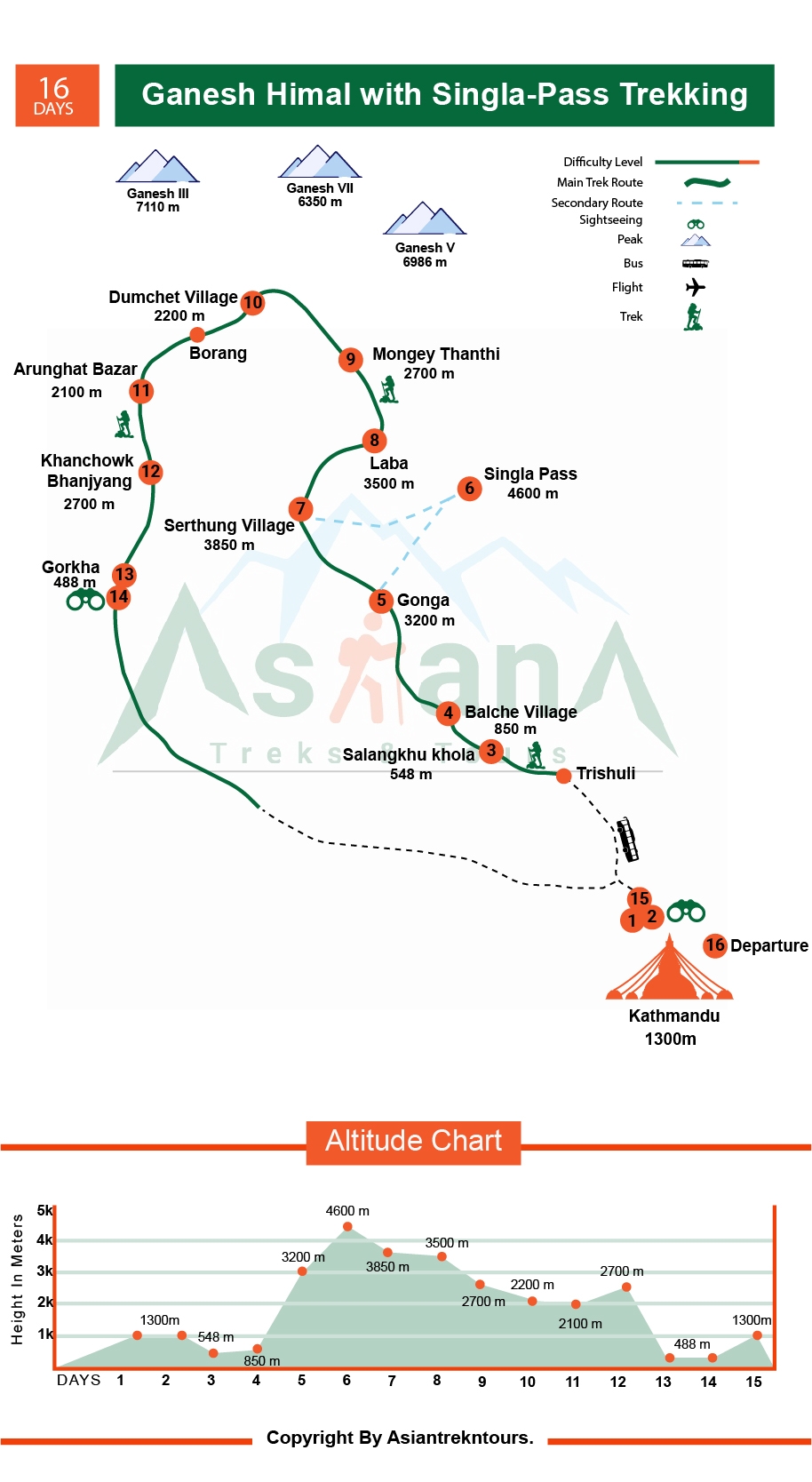
Experience the remote beauty of Nepal on the Ganesh Himal with Singla Pass Trekking. Starting from the vibrant city of Kathmandu, the trek winds through lush villages, serene rivers, and high mountain passes, including the dramatic Singla Pass (4600 m). This 16-day adventure combines cultural immersion, off-the-beaten-path trails, and breathtaking Himalayan panoramas, making it ideal for travelers seeking both challenge and discovery. The journey concludes back in Kathmandu, giving you a chance to explore heritage sites before departure. Asiana Treks and Tours ensures a well-organized, safe, and culturally enriching experience.
Transportation Terms
Accommodation / Meals Terms
Money & Payments / Travel Insurance
Travel Documents
Common Travel Phrases / Sightseeing
Off the Beaten Path
Travel Advisory
Health & Safety
Your Start Date is the day you land in Nepal, and your End Date is when you fly home.
If the set Ganesh Himal with Singla Pass Trekking group dates don’t suit your schedule, we can offer alternative dates upon request.
Base Layers
Insulation Layers
Outer Shell (Weather Protection)
Trekking Pants & Casual Wear
Head & Neck Wear
We went on an 8 day trek with Thakur Sapkota back in 1994 and remember both him and the trek as amazing. He very generously invited us to his fathers house where we had a little dinnerparty. A very special and fun evening. A very experienced and great guide who has kept it going for many years now. I strongly recommend his services.
The Ganesh Himal with Singla Pass Trek is a 16-day off-the-beaten-path adventure in central Nepal. Offered by Asiana Treks and Tours, it combines natural beauty, remote cultural villages, and spectacular mountain views. The trek passes through diverse terrains, from lowland river valleys to alpine forests and high-altitude passes. One of the major highlights is crossing Singla Pass (4600m), offering panoramic views of the Ganesh, Langtang, and Manaslu Himalayan ranges. It’s ideal for trekkers looking for authentic, less-commercialized trails.
The Ganesh Himal with Singla Pass Trek is rated moderate to challenging. While no technical climbing is involved, trekkers must be in good physical condition to handle long days of walking, steep ascents, and high altitudes. The Singla Pass at 4600 meters presents a tough but rewarding challenge. Asiana Treks and Tours ensures proper acclimatization, pacing, and support. Prior trekking experience is helpful but not mandatory for physically fit individuals with strong determination and a love for nature.
The highest point on this trek is Singla Pass, which stands at an elevation of 4600 meters (15,091 feet). This high mountain pass offers breathtaking panoramic views of the Ganesh Himal, Langtang, and Manaslu ranges. Acclimatization is key to handling this altitude safely. Asiana Treks and Tours includes a gradual ascent in the itinerary to help prevent altitude sickness and support your health and comfort. Guides are trained in altitude safety and carry essential first aid during the entire trek.
This trek is best suited for trekkers with some prior hiking or multi-day trek experience, due to its duration and high-altitude challenges. However, beginners who are physically fit, mentally prepared, and adventurous can also attempt it with the guidance and support of Asiana Treks and Tours. The itinerary is designed for gradual acclimatization, and porters are available to carry heavy bags. Proper pre-trek preparation, like cardio training and hiking practice, is highly recommended for first-timers.
The trek begins with a scenic drive from Kathmandu to Trishuli (72 km, approx. 5 hours), followed by a short trek to Salangkhu Khola. Asiana Treks and Tours arranges comfortable private transport for this journey. The drive itself offers views of terraced hillsides, rivers, and rural life, making it a great introduction to the region. After this point, the trail progresses through traditional villages and natural landscapes on foot, eventually circling back toward the Kathmandu region by Day 15.
To complete the Ganesh Himal with Singla Pass Trek, you need a moderate to high level of fitness. You’ll be trekking 5–7 hours daily over varied terrain, including uphill climbs, forest trails, and high-altitude passes. Asiana Treks and Tours recommends preparing through regular hiking, cardio workouts, and strength training for a few months prior. While you don’t need to be an athlete, good stamina and strong legs are important. The reward is unmatched natural beauty and cultural discovery.
Asiana Treks and Tours prioritizes trekker safety and prepares for emergencies with trained staff, first aid kits, and communication systems. Guides are trained in basic medical response and altitude sickness protocols. In severe cases, helicopter evacuation can be arranged, especially near Singla Pass or remote villages. The company works with local contacts and emergency services for quick responses. However, trekkers must have insurance that covers these costs. All precautions are taken to prevent incidents in the first place.
The Ganesh Himal with Singla Pass Trek is special for its remote, non-touristy routes, authentic Tamang and Gurung villages, and unspoiled natural scenery. Unlike the crowded Everest or Annapurna trails, you’ll often find yourself walking for hours without meeting another group. The trek also offers stunning views of Ganesh Himal, Langtang Lirung, and Manaslu, with rich biodiversity and high alpine terrain. Asiana Treks and Tours emphasizes community-based tourism, giving you a meaningful connection with local culture.
Yes, as the trek reaches 4600 meters at Singla Pass, altitude sickness is a potential risk. Asiana Treks and Tours follows a gradual ascent strategy, allows time for acclimatization, and trains guides to recognize and respond to symptoms. Drinking plenty of fluids, eating well, and trekking slowly help prevent AMS (Acute Mountain Sickness). If symptoms arise, the guide may recommend rest, descent, or emergency evacuation. Being honest about your health and following guidance ensures a safe experience.
Electricity is available in most villages, though it may be limited and not always reliable. Charging is done through solar panels or small hydropower, and some teahouses may charge a small fee per device. Asiana Treks and Tours recommends bringing power banks or solar chargers to stay connected, especially in higher, remote regions. You should also keep devices in airplane mode to conserve battery life. Some areas may not have network coverage, so prepare accordingly.
This trek offers deep immersion into Nepal’s ethnic communities, especially the Tamang, Gurung, and Ghale peoples. You’ll experience traditional homes, Buddhist monasteries, local foods, and warm hospitality in remote villages like Balche, Serthung, and Laba. Asiana Treks and Tours encourages respectful cultural exchanges and can arrange village walks, local interaction, and even participation in seasonal festivals if timing allows. The trek is as much a cultural journey as it is an adventure through the Himalayas.
Asiana Treks and Tours keeps its trek group sizes small and intimate, typically between 2 to 10 participants. This ensures better group cohesion, personalized attention from guides, and less environmental impact. Private treks can also be arranged for families or custom groups. Small sizes also allow for greater flexibility during the trek, making it easier to adjust pace, explore local areas, and enjoy a more personal experience throughout your journey in the Ganesh Himal region.
The best seasons to undertake the Ganesh Himal with Singla Pass Trek are spring (March to May) and autumn (September to November). During these months, the weather is stable, skies are clear, and mountain views are at their best. Spring also brings blooming rhododendron forests, while autumn offers post-monsoon freshness. Asiana Treks and Tours organizes trips during these ideal windows to ensure trekkers have the safest and most scenic experience possible. Winter and monsoon are less recommended due to extreme weather.
Trekkers need a TIMS (Trekkers’ Information Management System) card and a Langtang National Park Entry Permit, as part of the Ganesh Himal region falls within the park boundaries. Asiana Treks and Tours handles all the permit arrangements for you, including paperwork, fees, and issuance. You just need to provide passport details and photos. The company ensures compliance with all local regulations so you can focus entirely on enjoying your journey and the incredible Himalayan scenery.
Booking your Ganesh Himal with Singla Pass Trek is easy with Asiana Treks and Tours. Visit their official website or contact them via email or phone. A small deposit is required to confirm your reservation, and the balance can be paid before or upon arrival in Kathmandu. The team will guide you through every step—from permits and packing lists to airport pickup and pre-trek briefings. Their customer support is responsive, professional, and always focused on your satisfaction.
Accommodation during the trek ranges from basic teahouses to homestays, depending on the location. These offer simple but clean rooms, typically with shared toilets and limited electricity. In Kathmandu and Gorkha, you’ll stay in comfortable hotels or guesthouses selected by Asiana Treks and Tours. The company emphasizes cultural immersion and community-based tourism, so expect a warm and authentic experience in the remote villages along the route. All accommodations are vetted for safety, cleanliness, and hospitality.
Asiana Treks and Tours provides three meals a day (breakfast, lunch, and dinner) during the trek. Meals are typically Nepali-style, such as dal bhat (rice, lentils, and curry), but menus also include pasta, noodles, soup, eggs, and seasonal vegetables. In Kathmandu and Gorkha, breakfast is included while lunch and dinner are your choice. Clean, boiled drinking water is also provided during the trek. The company takes care to accommodate dietary preferences and ensures hygienic meal preparation.
Yes, every trek with Asiana Treks and Tours includes a licensed, English-speaking trekking guide and experienced porters to carry your gear. The guide provides cultural insights, ensures your safety, and handles logistics. Porters carry up to 20–25 kg of your luggage (shared between two trekkers), so you only carry a light daypack. The company treats its staff ethically, following fair wage and porter welfare guidelines. A guide-to-guest ratio is typically 1:6, ensuring personalized attention.
You’ll need layered clothing, a good pair of trekking boots, a sleeping bag, and essentials like a daypack, headlamp, water bottle, sunscreen, and personal hygiene items. Weather can vary greatly, so include both warm gear (down jacket, thermal layers) and light clothing for lower altitudes. Asiana Treks and Tours provides a full packing list upon booking and can assist with gear rentals in Kathmandu if needed. The team helps ensure you're properly equipped for all conditions.
Yes, travel insurance is mandatory for all treks with Asiana Treks and Tours. Your insurance should cover high-altitude trekking (up to 5000m), emergency evacuation, medical treatment, and trip cancellations or delays. Proof of insurance is required before the trek starts. While emergencies are rare, having coverage ensures peace of mind and access to immediate help if needed. The company’s team is trained to coordinate rescue operations in case of serious illness or accidents.


 (2)
(2)  100% recommend (0)
 (0)
(0)